No Cool? No Heat? No Power? Call us today: (02) 8061 5023
⏰ Need Urgent Help? Limited Emergency Breakdown Slots Available Each Day (No-Cool ❄️ No-Heat 🔥 No-Power ⚡️). Call Now ☎️


Australia is famous for its scorching summers and sunny office workspaces, but not every workplace has the best air conditioning system. Many workers spend long hours in offices where the temperature swings between too hot and too cold, affecting their comfort, health and productivity.
We wanted to find out the real impact of fluctuating temperatures during summer. To do this, we surveyed 1,000 Australian adults who work in an office at least one day a week. Participants were asked about several key areas, including how many productive workdays they lose each week, how many hours of sleep they miss during hot nights, and how their behaviours are affected by heat, cold, or both.
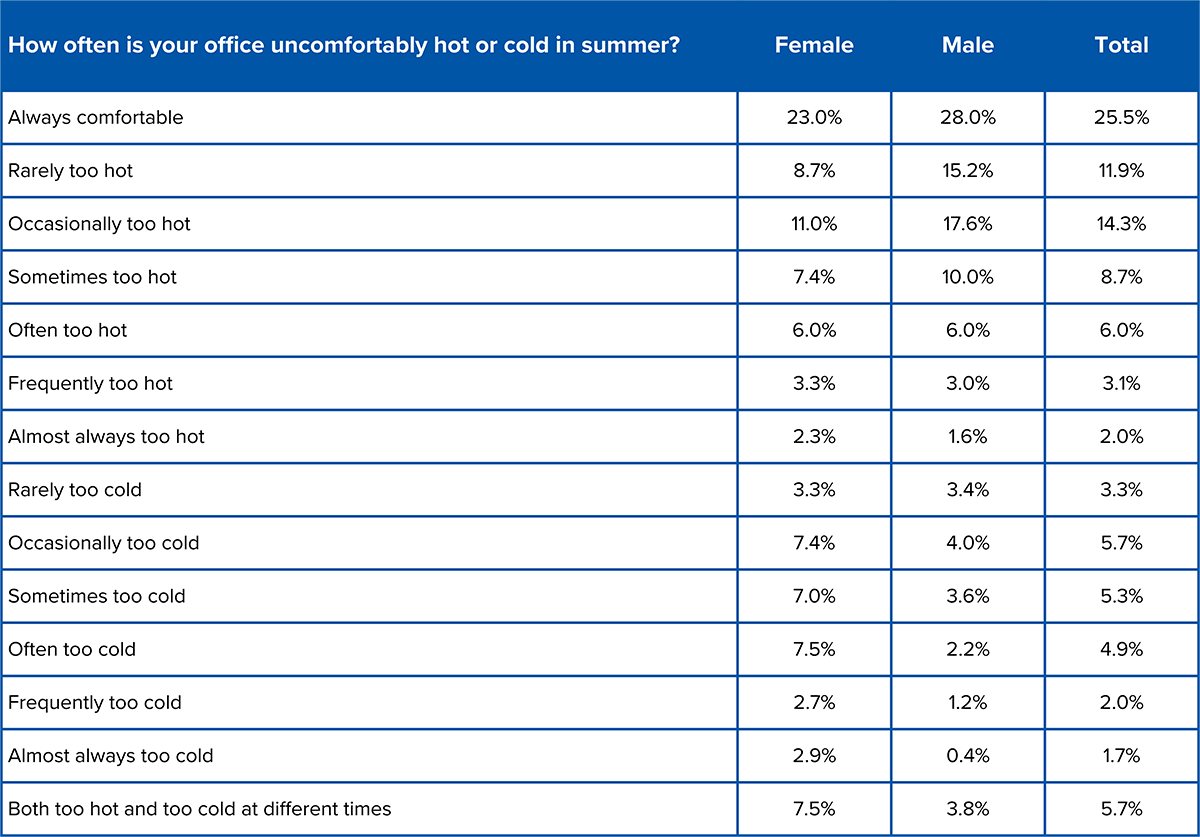
During the summer, employees who are in the office five days a week usually experience about one full day of the office being too hot (0.95) and a half day of it feeling too cold (0.64). Only one in four (25.5%) workers say their office is always comfortable in summer.
‘Overheating’ is a common workplace issue, as 34.0% report their office is too hot for at least one in four office days. Cold discomfort is less frequent in summer but still affects about one in five respondents (19.6%). Interestingly, 5.7% regularly switch between feeling too hot and too cold, suggesting that some workplaces may have inconsistent or ineffective air conditioning.
Heat is also a similar issue between men and women, with both experiencing roughly one hot day per five-day work week. Feeling cold, however, is more of a problem for women, who report the office being too cold on about 18% of summer workdays, compared to just 7% for men.
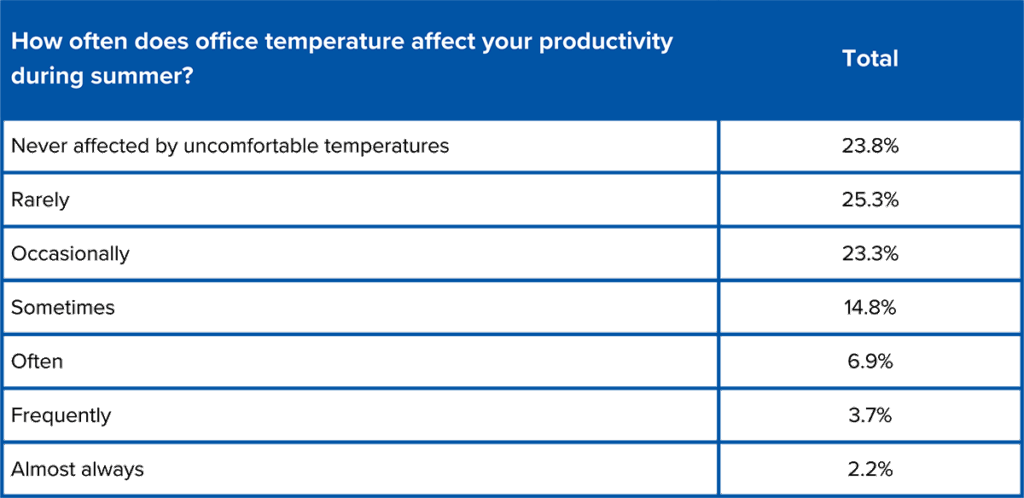
In a typical work week, productivity is affected on 23.5% of summer workdays, which amounts to about 1.17 days over five days in the office. Remarkably, this can cost Australian businesses an estimated $5.64 billion in lost productivity each summer. On an individual level, office workers lose about 0.30 days of effective work per week due to uncomfortable temperatures, and when this effect is scaled across all office employees in Australia, the economic consequences are substantial.
Overall, women report greater productivity impacts than men, averaging 1.28 affected days per work week compared with 1.06 for men over 5 office days. Additionally, around 2.2% of all respondents said they are almost always impacted by the office temperature.
Even though productivity is affected for some, 23.8% of employees said they’re never bothered by uncomfortable temperatures, and over a quarter (25.3%) said it happens rarely, roughly one in ten office days. In fact, just 6.9% reported that their productivity is often impacted (three in five days), and only 3.7% said it’s affected frequently (four in five days).
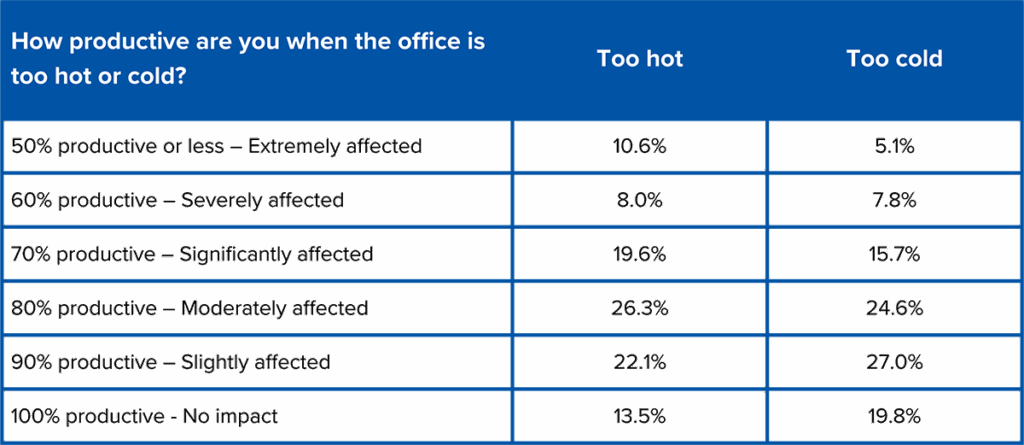
The survey shows that office heat has a stronger negative impact on productivity than cold. The most common response was that employees feel around 80% productive when it’s too hot (26.3%). For cold conditions, most respondents said they remained at least 90% productive (27%). Interestingly, over one in ten respondents (13.5% and 19.8%) reported that temperature, hot or cold, had no impact on their productivity.
On hot days, women and men have similar average productivity, 77.7% and 78.7%, respectively. However, on cold days, women average 81.6% productivity and men average 82.4%. At the extreme, 12.2% of women and 9.0% of men report being 50% productive or less when the office is too hot. In cold conditions, the impact is smaller, with 5.6% of women and 4.6% of men falling to 50% productivity or below.
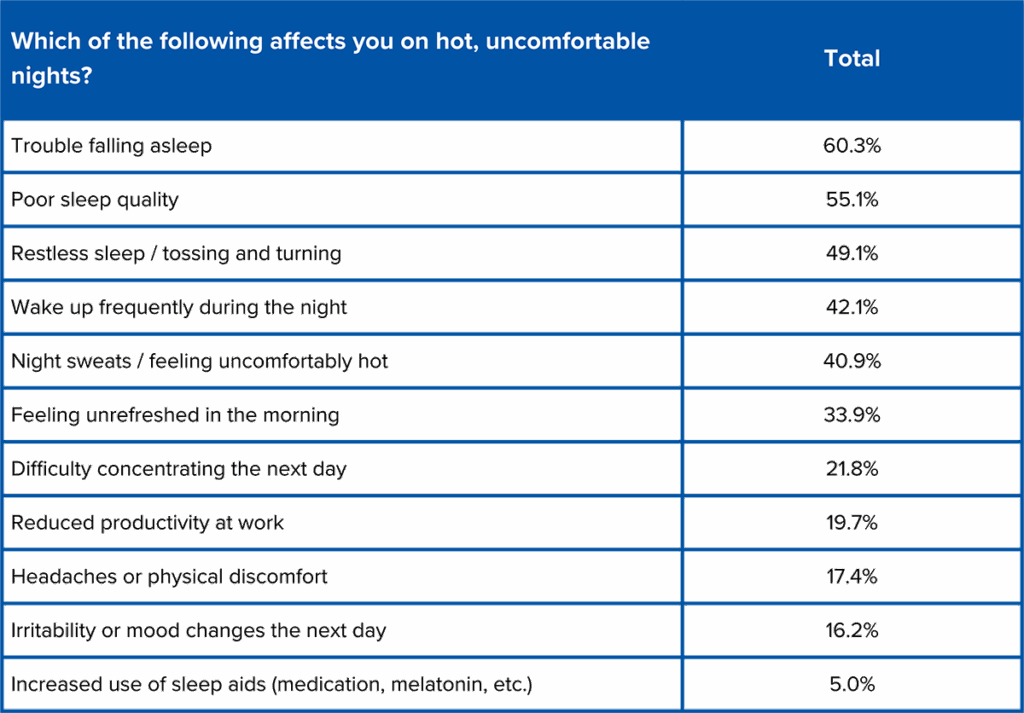
The impact on workplace productivity can also begin before the workday begins. On uncomfortably hot nights, over half (60.3%) of workers report having trouble falling asleep and getting poor quality sleep (55.1%). Nearly half (49.1%) also experience restless sleep, which can also lead to waking up frequently during the night (42.1%).
The effects of poor sleep clearly carry into the next working day. On hot nights, workers lose an average of 1.35 hours of sleep. Only 8.8% reported that their sleep remains unchanged, meaning that almost all respondents (91.2%) experience some sleep impacts. The next day, over a third (33.9%) feel unrefreshed, and more than a fifth (21.8%) have difficulty concentrating. Almost a fifth (19.7%) also cite a reduced productivity at work, highlighting how inadequate rest at home can directly affect job performance.
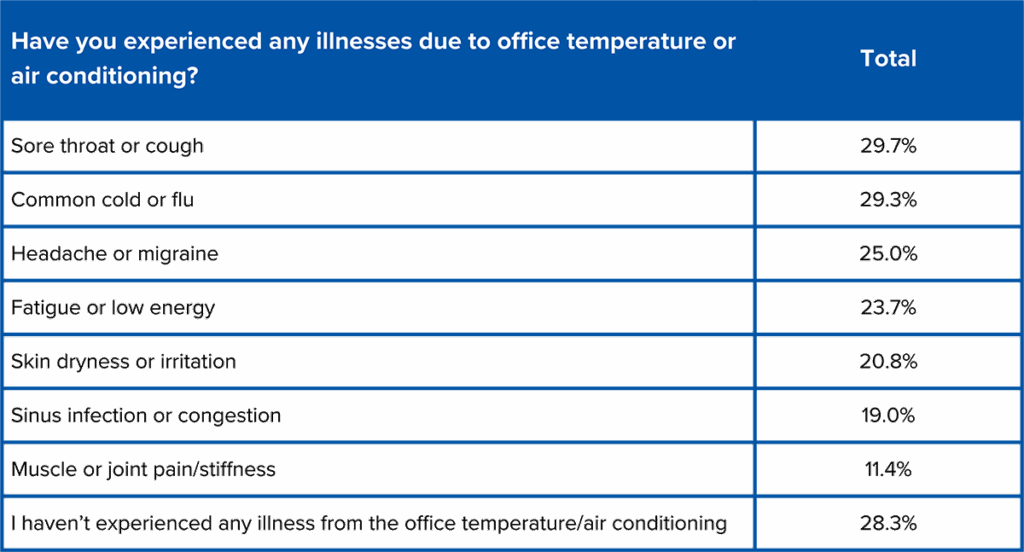
Office temperatures and air conditioning aren’t just a matter of comfort; they could also be making employees sick. Three in four (71.7%) report at least some symptoms they attribute to the office temperature or air conditioning, while only 28.3% of workers say they have not experienced any illness from it.
The most commonly reported health issues include sore throat or cough (29.7%) and the common cold or flu (29.3%), each affecting nearly a third of workers. Headaches or migraines also impact one in four employees (25.0%), alongside fatigue or low energy at 23.7%. Skin dryness or irritation affects about one in five workers (20.8%), and sinus infections or congestion are close behind at 19.0%.
Interestingly, younger workers are the most likely to report illnesses they associate with office temperature or air conditioning. In fact, just 18% of 18-24-year-olds say they have not experienced any related health issues.
Office temperature can also shape employee behaviour, leading to issues such as disagreements with coworkers, increased anxiety or irritability, longer breaks, and a greater likelihood of working from home. Men and women report a similar number of temperature-related behaviours, with both groups reporting six to seven distinct behaviours influenced by how warm or cold the office feels.
For instance, nearly half of men (42.2%) and more than half of women (51.5%) say their decision-making slows when the office is too hot. When it’s too cold, a fifth of men (21.8%) and women (23.8%) have disagreements with their coworkers about the office temperature. One of the most common shifts in behaviour occurs in hot conditions: feelings of stress, anxiety, or irritability, reported by 47.4% of men and 52.8% of women.
However, women reported slightly more cold-related behaviours (3.5 vs. 3.2), while men reported slightly more heat-related behaviours (4.5 vs. 4.3). Women are more likely than men to wear extra layers or use a blanket when the office is too cold (60.5% vs. 42.8%). They also rely more on fans, heaters, or blankets to manage uncomfortable temperatures. Interestingly, men are more likely than women to adjust their work hours to avoid extreme temperatures, with 28.4% arriving late or leaving early when it is too hot, compared to 20.1% of women.
Overall, heat has a stronger effect on productivity-related behaviour. Around half of all respondents (46.9%) report slower decision-making and feeling more stressed or irritable (50.1%). Over a third (36.6%) also say tasks take longer to complete. Taking more frequent or extended breaks is also widespread, impacting 43.2% of workers.

“Our research shows that office temperature has a bigger impact on workers than many realise. When offices are too hot or too cold, it doesn’t just affect comfort; it can influence sleep, mood, and productivity. Uncomfortable office temperatures can lead to fatigue, irritability, and even push people to adjust how, when, or where they work.
“Office managers should work to maintain a consistent and comfortable office climate to help employees perform at their best, stay healthy, and feel comfortable. Managers can implement simple strategies such as regulating heating and cooling systems, allowing flexibility in how employees manage their environment, monitoring the temperature and communicating temperature policies. This can make a big difference in supporting wellbeing and productivity during the summer months.”
This research is based on an online survey of 1,017 Australian adults, conducted by independent panel provider PureProfile. The sample is nationally representative by gender, age and state, and all figures relate to people who work in an office at least one day a week.
To keep comparisons robust, some very small demographic groups were excluded from comparative analysis (specifically, people aged 75+ and respondents from NT, ACT and TAS). Where relevant, results are reported by gender, age group, and state.
Alongside simple percentages, we have created a number of derived metrics to show the real-world impact of temperature and air conditioning. These include: “actual” lost productivity days per week based on each respondent’s in-office schedule, and a normalised “5-day equivalent” which shows how many days of a standard 5-day office week would be affected if workers experienced impacts at the same frequency.
For sleep, we also calculate weighted average hours of sleep lost per uncomfortably hot night using mid-points of the time bands, and for behaviour, we count the average number of distinct behaviours affected by hot, cold, or both.
All results are based on self-reported experiences during summer, and many questions allowed multiple responses, so percentages can sum to more than 100%. Some figures may not add up exactly to totals due to rounding.
The economic cost estimate is calculated by combining respondents’ self-reported productivity loss with the ABS average weekly earnings to assign a daily economic value across a 13-week summer period. The analysis applies this per-worker seasonal loss to an estimated national office-based workforce of 4.69 million people, derived from ABS Labour Force data by identifying occupation groups most likely to work in offices. This provides a conservative, data-driven national estimate meant to show the scale of potential economic impacts, acknowledging that it uses average earnings, broad occupational assumptions, and self-reported behaviour, and does not adjust for wage differences, workplace conditions, or climatic variation.